
ITHACA ICR
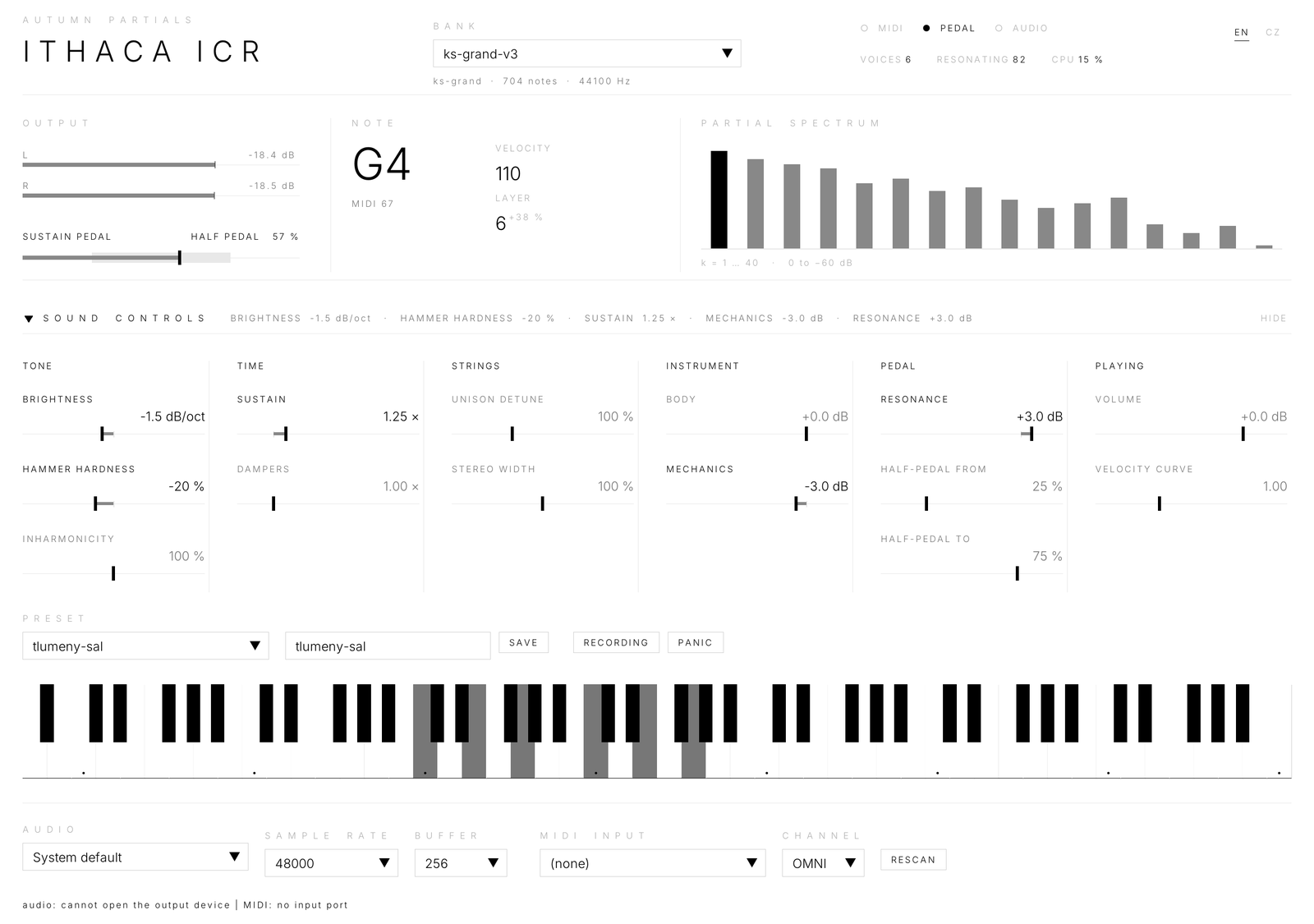
A piano that is not played back, but reborn. An innovative approach built on mathematical modelling turns a recorded instrument into one you can reshape as you play — brighter, softer, longer, a little out of tune.
- Engine functional
- Half-pedalling
- Sympathetic resonance
- Continuous velocity
- 14 tone controls
- In tuning
Listen
Straight from the instrument — no reverb, no processing. One short original piece in five voicings, then a few close-ups.
-
01As recordedAll controls at neutral — the instrument as it was born.–:––
-
02Muted hallDarker spectrum, softer hammers, a little more sustain and resonance.–:––
-
03Bright concertMore upper partials and harder hammers — a piano that cuts through.–:––
-
04Honky-tonkThe two or three strings of each key pulled apart in pitch. Same notes, same bank.–:––
-
05Long sustainEvery decay time stretched — an instrument that does not exist.–:––
-
06Recording vs. resynthesisSix notes, each first as the original recording, then as reborn by ICR.–:––
-
07Velocity, continuouslyRepeated notes from pianissimo to fortissimo. The colour opens up gradually, with no steps.–:––
-
08Half-pedalA chord under the pedal, then the pedal lifted only half-way: the dampers touch the strings, the treble fades, the bass keeps ringing. Then the same chord with a plain release.–:––
-
09Sympathetic resonance, off / onA short staccato chord with the pedal down — first without, then with string resonance. After the keys are released, the open strings carry on.–:––
From a recording to an instrument
A sampler plays recordings back. ICR listens to them once, learns what every string is doing — and from then on plays from that knowledge alone. How exactly? That stays in the workshop.
Shape it like a synthesizer
Because ICR understands the piano rather than replaying it, its character is yours to shape — fourteen controls, live, while you play. Any of them can be mapped to a knob on your MIDI controller.
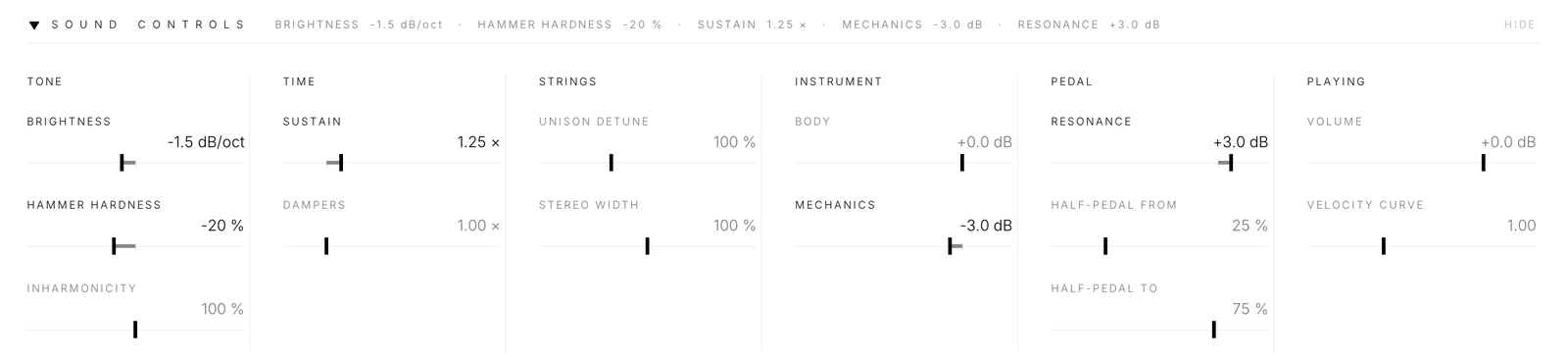
Tone
- Brightness
- Hammer hardness
- Inharmonicity
Time & strings
- Sustain
- Dampers
- Unison detune
- Stereo width
Instrument & pedal
- Body
- Mechanics
- Resonance
- Half-pedal zone
- Volume, velocity curve
The right pedal, properly
Half-pedalling
The pedal is read as a smooth movement, not a switch. Half-way down, high notes fade quickly and low ones keep ringing — the colour pianists reach for.
Sympathetic resonance
With the dampers lifted, the strings that share something with the music begin to ring along — quietly, as inside a real piano.

The engine works and plays, and the whole keyboard now behaves as one instrument.
Honestly: on good headphones, the sampler (Ithaca Legacy) is still the more convincing piano. ICR is where the piano becomes playable in ways a recording never is. Work on the tone continues.